Overview
This article explains who is eligible to apply for study leave and what types of costs can be funded for medical and dental doctors in training under London PGMDE arrangements.
Study leave funding exists to support curriculum delivery, progression through training, and maintenance of professional competence where this cannot reasonably be provided locally by the employing organisation.
Key principles
All doctors in training have 30 days study leave a year to undertake training relevant to their curriculum (15 days for F1 doctors).
Study leave funding is provided to support attendance of approved training courses and conferences. It is not an automatic entitlement.
Priority will be given to courses that help resident doctors meet curriculum or assessment requirements of the resident doctor’s current training programme.
Employers remain responsible for providing mandatory local education and statutory training.
All study leave should be approved in advance and must provide value for money.
Eligible resident doctors apply to their trusts for reimbursement of study leave expenses, and the trusts are then reimbursed by NHS England.
Who this article applies to
This article applies to postgraduate medical and dental doctors in training who hold a National Training Number and are in a London placement in an approved training post.
Who is eligible for study leave
Resident doctors in approved training programmes may apply for study leave where the activity is relevant and appropriate for curriculum progression or assessment.
Eligibility depends on the resident doctor remaining in programme and complying with local study leave policy requirements.
Who is not eligible
Resident doctors are not eligible for funded study leave if they are out of programme, have completed training or are in a period of grace, or are undertaking activity unrelated to their approved curriculum. Exceptions are those who are out of programme for training or who need to take a training course within a month before returning to training after a prolonged period out of training (e.g. for maternity leave or research).
Study leave funding is not available for employment-related activity that should be provided by the employer.
What can be funded
Funding may be provided for courses and conferences that are essential to or support the meeting of curriculum competencies or assessment requirements.
Examples include essential curriculum courses, courses or conferences that are approved as supporting the curriculum, and necessary travel and accommodation where the activity is not available locally.
NHS Trusts and other providers may be directly funded for locally delivered courses where prior approval has been obtained and the course supports curriculum requirements for specified training programmes. See the article on study leave locally delivered courses for more information.
Travel and accommodation expenses to attend exams which are a curriculum requirement may be claimed using the code TRAC0001. Resident doctors should check the relevant specialty course list to confirm that this code applies to their training programme. We are aware of the recently accepted national agreement regarding reimbursement of the first two attempts of mandatory Royal College examinations from 1 April 2026 by NHS Employers. However, the Department of Health has not yet issued formal guidance on the reimbursement process. Please retain your receipt and await further guidance. A list of eligible exams can be found on the website here.
What cannot be funded
Consultant or interview preparation courses are not eligible for funding.
A maximum of one international course or conference may be supported per training programme if prior discretionary approval is obtained. For this purpose, a run-through programme is considered as being a core training programme followed by a higher training programme, thus allowing one international funded study leave activity in each part. Funding is not available for additional international courses or conferences.
Funding will not duplicate employer responsibilities such as mandatory statutory or trust-required training.
Regional Training Days
Regional training days form part of each approved training programme. These require local approval from your employer for the study leave time and are usually deducted from your annual study leave allowance. However, please confirm the correct process for your specialty with your TPD.
Approval principles
All study leave should be applied for and approved in advance.
Approval considers training relevance, service impact, cost, and availability of funding.
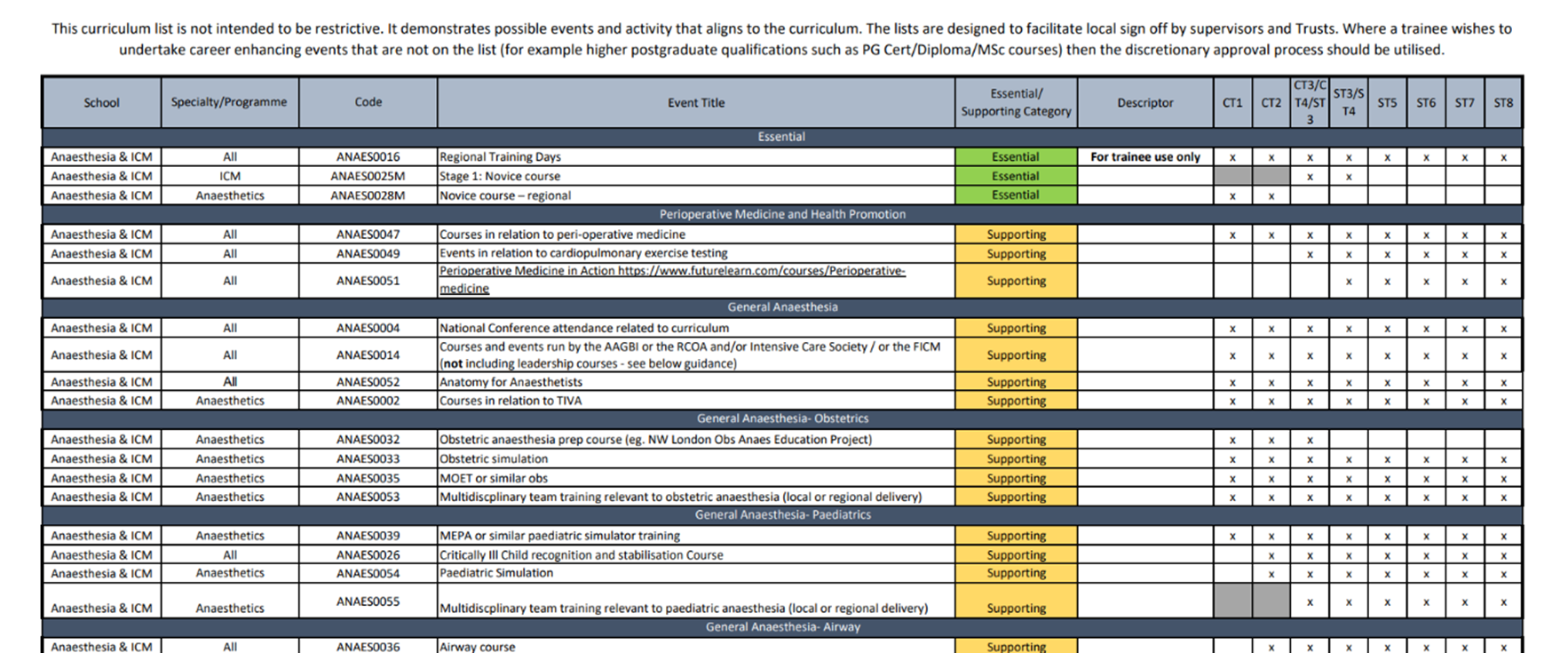
Course lists are provided on the PGMDE Support Portal (PSP) for each specialty, identifying all essential and supporting courses which have prior approval for specified grades of resident doctor. Any course or conference which is not specified on the course list for the given specialty and grade of resident doctor will require prior discretionary approval by the resident doctor’s TPD and Head of School (or Associate Dental Dean for Dental trainees).
Here is an example of a course list for Anaesthetics and Intensive Care Medicine:
Conditions and limitations on funding
There are some limits specified in the published course lists, giving the maximum that will be funded for a specific course.
Funding for international events will only be provided for either the conference/course fee or the travel and accommodation, whichever is the lower amount.
For exam preparation courses, resident doctors are able to claim for one course per exam component per sitting. Additional courses for the same exam would require discretionary approval, as would courses for any exam resits
The following expense limits also apply:
Accommodation expenses outside London | £120 per night |
Accommodation expenses in London | £150 per night |
Mileage rate | 30p per mile |
Subsistence costs | Lunch: £5 Evening meal: £15 Meals in 24-hour period: £20 |
How to apply
All time off for study leave must be supported by the resident doctor’s educational supervisor. Applications for study leave funding must also be supported by the educational supervisor and, except for resident doctors undertaking Palliative Medicine higher training, be submitted via the resident doctor’s Employing Body’s local study leave expenses process, quoting either the relevant course code from the current published course list or the discretionary course code issued by the London HET study leave team. Resident doctors undertaking Palliative Medicine higher training should submit claims to the London study leave team, which will forward approved claims on to the Palliative Medicine Lead Employer for payment through the next payroll run. Funding claims may be submitted as soon as costs are incurred and should be submitted no later than 3 months after the date of the course or conference, subject to any additional time restrictions specified in the Employing Body’s study leave expenses process.
Supporting documentation must demonstrate curriculum relevance and cost justification, providing copies of receipts or other evidence of expenditure, as required by the Employing Body’s study leave expenses process.
For a summary of the full process from application to reimbursement, please see the study leave process flowchart here.
When funding may need to be returned to the Employing Body
If an expense claim is made prior to attendance of the study leave event and then the resident doctor is unable to attend the event for any reason, the Employing Body has the right to recover the funding from the resident doctor. The amount to be recovered may be reduced if the resident doctor is able to be provide evidence that some of their expenses are non-refundable.
If funding is provided that unintentionally exceeds the amounts allowed by the London PGMDE study leave arrangements, the Employing Body may need to recover the overpayment from the resident doctor.
Further information and support
Further guidance is available in related articles on the London PGMDE Support Portal (PSP) and the and course lists here.
Resident doctors should approach their Employing Trust for guidance on the expenses claim process.
Palliative Medicine resident doctors may approach the London study leave team for guidance on their expenses claim process. The Palliative Medicine study leave application form can be accessed here.
All resident doctors should first discuss their training needs with their educational supervisor.
Resident doctors and Trusts should access the course lists through the PSP here.
Resident doctors should obtain the discretionary study leave application form from PSP.
Related articles
- Discretionary study leave applications: what counts and how to apply
- Study leave: locally delivered courses and claiming by Trusts
- Study Leave Course List
Last reviewed
Last reviewed: October 2026
Was this article helpful?
That’s Great!
Thank you for your feedback
Sorry! We couldn't be helpful
Thank you for your feedback
Feedback sent
We appreciate your effort and will try to fix the article